Gordon Willis's philosophy on thin negative exposure and exploration in dynamic range as a tool
After spending this week studying Gordon Willis's work on The Godfather I and II, I stumbled upon old American Cinematographer articles in which Willis explained his very defiant approach to exposure.
The Godfather I and II were shot on Eastman 100 ASA film. What is interesting about Willis's work on these two movies is his unorthodox methodology for exposing this discontinued film stock. General exposure philosophy, and the philosophy of other film-age cinematographers, and even some digital-age DPs, is to push the image in-camera and pull it down in the DI or the lab.
Pushing one stop Eastman, or more commonly, Kodak Vision 2/3, provided a "thick negative". DPs were shifting the film's dynamic range one stop towards the highlights. Providing a cleaner grain profile in the shadows, increasing contrast, and providing creamy highlight details. Pushing one stop of 7219 stock rated at 500asa would require metering at 250asa, effectively tricking the DP into lighting one full exposure value brighter (backwards, I know). This shifts the 7219's 14+ stop dynamic range by one stop towards the shadows, borrowing that stop from the highlights.
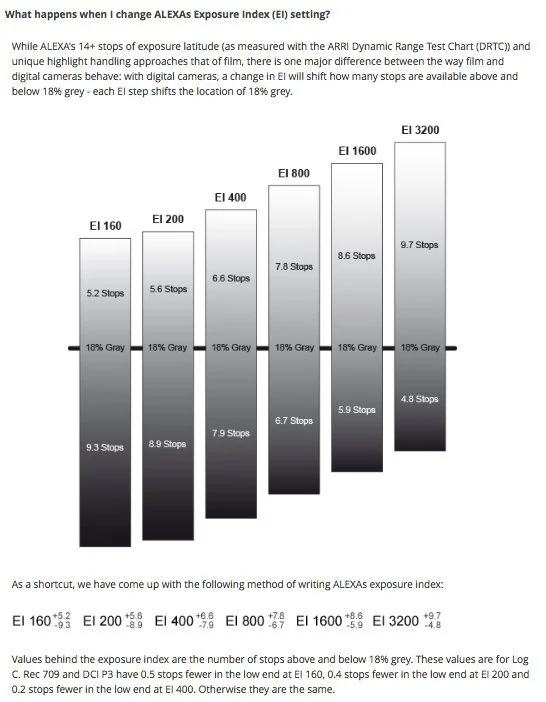
This has been a major focus of my studies lately. How do we use a stock or sensor’s dynamic range as a creative tool instead of a technical choice? Dynamic range is a sliding scale available to our disposal. It is certainly not just a technical sensor spec. Setting the EI to 800 on the Alexa sensor ensures that all of our information is evenly distributed between our shadows and highlights. There are realistically only 5 usable stops on each end, 6 if using the new ES modes on the 35. Arri's tech specs say 14+ stops, but in real-world environmental tests, I have found something closer to 10 stops while preserving image quality.
Using the sliding scale then allows us to use dynamic range as a tool at our disposal. With set stock box speeds and with many digital cameras using base EI, this tool becomes immeasurably more important to our work. Thinking of stops as buckets, separated linearly, with 5 on each side of your point of control (key, middle grey, basically what you're metering to) is a simple way to imagine how this concept works. You're stuck in the middle of the desert with 10 buckets to capture rain, you line them up in a straight line to capture water, you're obviously going to be constantly shifting the position of the buckets back and forth to capture the most amount of rain depending on where it's falling. In this case, the rain is light; the buckets represent the dynamic range, and we want to capture as much of that data as possible.
A simple way of thinking about distributing the buckets.
To the nerds out there, many digital sensor gamma curves (Slog, LogC) are logarithmic, and not linear, so in this metaphor, you can set your buckets up in an S-curve.
When exposing an image, we always meter (expose) to our POC. Whether using false color, a physical meter, or math (there are other tools that I just don't believe in: Zebra, waveform, histogram), we're setting our exposure to that reading and lighting around it. That reading will not change; it is now the midpoint where our buckets fall.
By pushing a stop, as mentioned above, we expose a stop under our base (base here being used interchangeably between a film's box speed, and a sensor's native ISO), effectively shifting one bucket towards the shadows, 6 buckets shadow, 4 buckets highlights. You'll capture more data in the shadows and less in the highlights. The result? Cleaner shadow grain profiles, an increase in contrast, and better skin replication. That said, by taking a bucket from our highlights, we are more susceptible to clipping, which, in most applications, we want to avoid. We flood our sensor or silver halide with more light, creating a "thick negative". While shifting our buckets to the left.
By pulling a stop, we intentionally underexpose the negative. We expose a stop over our base (backwards again, but true), resulting in shifting buckets away from our shadows into our highlights. The result? A "thin" negative. We observe a higher shadow grain profile, decreased contrast, and more detailed highlights. The same applies to pushing: when we pull, we have to be cognizant of our shadow exposure, because we are reducing the data there and become susceptible to muddy shadows. We're starving our sensor or silver halide of light and creating a "thin negative". While shifting our buckets to the right.
So at the 800ei base on the Alexa, reading a t4 for my POC, if I would like to push, I can either reduce my EI in camera to 400ei (one stop) to increase the amount of light into the shadows, and continue at my t4, or I can use a t2.8 at 800ei for my POC, and light that way. Likewise, for pulling, I can increase the EI to 1600 EI and increase highlight detail by one stop, or read a T5.6 for my exposure.
In the digital world, there are many useful applications for this. I like to shoot interviews at 400 EI, pushing one stop from the 800 base. I love shooting interiors or in the studio at 400 EI, or even 200 EI on digital sensors. If you have solid control over your highlights, this is a great option for increasing shadow detail and having a thicker toe. For exteriors, I'll extend my EI to 1250 or 1600 to control highlights, increase highlight detail, and prevent clipping. This is extremely useful for bright days, snow, and outdoor applications. I can't control the sky, but I can control the amount of negative fill on an actor’s face to preserve my shadows.
The most important part of all of this? The Lab, the DI, the Colorist. When shifting these DR buckets around, we eventually need to bring them back down to zero or back to 5-5. If pushing an image and intentionally overexposing, we'll get back to the grade with an overexposed and unflattering image. Relaying this exposure information to the colorist is crucial to the image's integrity.
This is an age-old technique originating in film work. If we push a stop on set, we need to pull it back down in post; likewise, if we pull a stop on set, we need to push it in post. This is the magic that has created the look of your favorite movies. This is what builds strong contrast, creamy highlights, fine grain, and those lovely skin tones. We want our POC that we overexposed to be post-processed back to middle grey. The colorist will bring the exposure back down or up to 5-5 and you’ll have a wonderful looking image if done correctly.
Many DP's will choose to push entire movies, commercials, etc. Always exposing their POC to +1 stop above their base. Then, when creating the look, bring it back down to the correct exposure in post. Which brings us to our next point: Gordon Willis's unorthodox technique in The Godfather series. We'll continue this discussion in detail in part two next week. For now, we've built a strong foundation of dynamic range exploration.
Feel free to correct me or provide feedback if any of this information is incorrect. I am writing these in an effort to expand my knowledge, philosophy, and skill as a cinematographer. This is how I've found to think of our most complex systems. I want to be wrong, I want to learn.
Explore, test cameras, buy a light meter, and have fun.
Until next week,
AJ